03 · Politics
Animals in
the room
I am interested in how we substantively represent nonhuman life, especially other species, in institutions, politics and governance.
I frequently deliver keynotes and talks on this subject. I am founding director, with Erin Ryan, of Animals in the Room – a business with a social mission developing methods for representing non-human animals in the decisions that affect them – and, with philosophers, scientists and animal-welfare specialists, of its charitable network. animalsintheroom.org
Selected keynotes, talks, and articles
2026
Natures in Translation: AI, Ethics and Environmental Conservation
A talk at the Natures in Translation conference at Lancaster University, exploring the ethical implications of AI-assisted animal translation for environmental conservation and human-environment relations.
Talk
2026
UN panel on animal welfare
Moderating a United Nations panel on animal welfare in New York.
Panel
2026
The Future of Animal Law
Keynote at the UK Animal Law Conference at the University of Birmingham, encouraging legal systems that recognise and support the agency of non-human animals.
Keynote
2025
Nature or the individual? Who or what to represent first in politics and law
Cambridge Centre for Animal Rights Law, Talking Animals series: whether representation should begin with whole landscapes, as in the Rights of Nature movements, or with individual animals capable of communicating their interests.
Lecture
2025
A deliberative walk
Running an Animals in the Room deliberative walk for the Environmental Funders Network – joined, at one point, by several inquisitive ducks.
Workshop
2024
Human–Wildlife Conflict: let's coexist peacefully
Keynote at the Animal Politics World Conference in Eindhoven, hosted by the Party for the Animals and the Animal Politics Foundation, on coexistence and the role Animals in the Room might play in it.
Keynote
2024
Co-creating Co-existence in a Multispecies World
Interspecies Internet lecture introducing the international project, based at NYU, studying how we communicate with other species, take their perspectives, and include them in our decisions.
Lecture
2024
More-than-human governance experiments in Europe
Animals in the Room among the projects convened by DemocracyNext and Arising Quo in The Hague to map the emerging field of more-than-human governance.
Convening
2023
The Who, How, When, and Why of including the voices of other species
Opening plenary keynote at the Radboud Conference on Earth System Governance, on why there is still no provision to include other animals as subjects of justice in human decision-making.
Keynote
2023
Animals in the Room: Why We Can and Should Listen to Other Species
Emergence Magazine: what it would take to expand the democratic imagination to include and represent animal voices.
Essay
2023
Who Speaks for the Whales?
Nautilus: rights for cetaceans are not enough. They also deserve representation.
Essay
2023
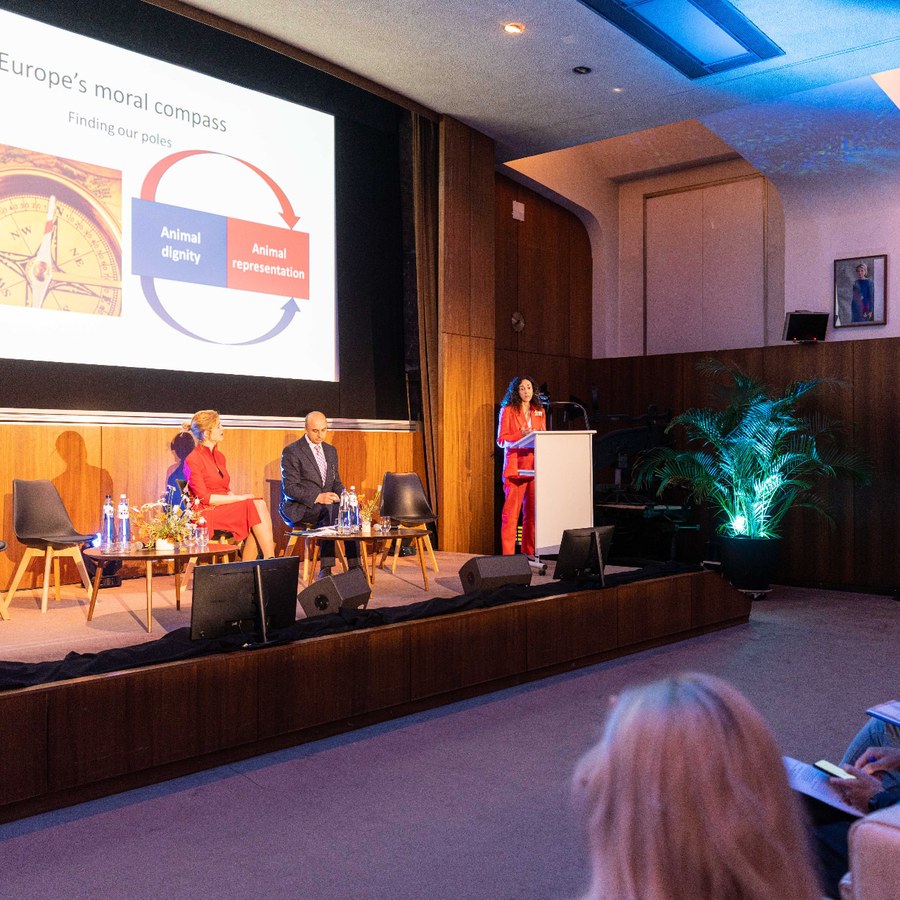
Animal Dignity and Animal Representation
Keynote at the Eurogroup for Animals Annual Conference in Brussels, alongside Peter Singer, on the new paradigms for advancing the interests and wellbeing of non-human animals.
Keynote
2020 –
Animals in the Room
Founding director, with Dr Erin Ryan, of a business with a social mission: developing and testing methods for representing non-human animals in the decisions that affect them. With philosophers, scientists and animal-welfare specialists, I also founded its charitable network to advance the work.
Project
In the argument
“Other living beings are subjects of justice that can communicate their interests to us: we just haven't experimented with democracy to figure out how to include them and to understand how to do it well.”
“It is the fact that they are subjects, that they are agents, that their voices matter in a political sense.”